| Status: | Active, open to new members |
| Facilitator: | |
| Group email: | The Lunartics group |
| When: | Website based |
| Venue: | On Line Group |
Hello there! Welcome to the ‘Lunartics’ Group page.
If you are interested in stargazing, with a little astronomy mixed in, coupled with a dash of science now and again; then this is the group for you.
I’m Frank Hill, and by no means an expert in all things to do with astronomy and the like. However, I do have an itch to see what is around us and above us and hope to try and understand where we came from.
From very ancient times we (us Earth dwellers) have the ability to recognize pattens, day, night, hot, cold, lights in the sky that seem to make unchanging shapes with an occasional interloper wandering among them. It was natural then, to make these shapes represent things we saw around us. Animals, such as snakes, birds, horses and of course men and women, all of these can be found in the sky to gaze at. The big difference now, is that we are starting to understand what these lights are and where they (and we) came from. In addition, we now also know that there are other worlds out there; thousands of them!
The ‘Lunartics’ are of course at present a virtual group, but as the year goes on and restrictions are eased, then the occasional meet up will be organized, and we may even get to do some actual observing!
If you would like to join in on this journey of discovery or have questions, then use our contact CBU3A email address: castleu3a2@gmail.com to forward them on and I will try my best to answer them.
Good viewing - Frank Hill

Comet Lemmon (C/2025 A6) October 2025
During October 2025 comet Lemmon, that was discovered in January 2025 by the Mount Lemmon Observatory in Arizona, will be seen below the tail of Ursa Major from the 18th October. Depending on your sky conditions it may be seen naked eye but you stand a better chance by using binoculars to sweep the area below the tail of Ursa Major and the bright Orange star Arcturus in the constellation Bootes.
It is moving towards this constellation and on the 21st October should be seen in the centre of this star group, it will then move on towards the constellation Serpens (the Serpent). This is a good opportunity to try out your astrophotograpy skills.
As a rough guide, you will need a tripod on which to mount your camera, the camera should have the ability to take long exposure shots. A 35 or 50mm lens will be good, set the focus at infinity, ISO (start at 100) and exposure set to ‘Brief’ (or at least 2 minutes if possible).
If you are observing the comet around the 18th of October, find the tail of Ursa Major and if visible from where you are setting up, locate the bright orange star Arcturus. Scan the area between and see if you can locate the comet. When the comet has been located, arrange the camera to point in this direction and open the shutter. If the camera shutter is on ‘Brief’ then leave the shutter open for at least 2 minutes, repeat this several times. The same goes for cameras with set exposure times.
On the 21st October the comet should be in the constellation Bootes, repeat the the set up as above but of course move the camera to point to the centre section of Bootes. Photos of the comet can be shown here of course.
Good viewing and good luck.
Sky at Night Diary
Cosmic Jury Time it is said, is without ending. Well, we had a beginning a few millennia ago with a great big bang and a cosmic ringing, this is the way of current thinking. There was a thought a while ago that maybe there was no big bang but a shiver and all the stuff, we see around has always been there safe and sound without the fuss and no great bang. That being said, with all the wonder, how did it start then without the thunder? We look again at what’s about and it does look like there was a clout that sprayed all the stuff in the universe about. The molecules of life were there being cast about without a care amidst the dust and fury that led to us……. The Cosmic Jury!
Jupiter
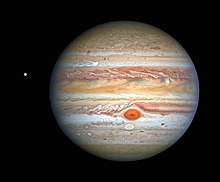
Largest planet in the Solar System, takes almost 12 years to orbit the sun, with a diameter just over 11 times that of the Earth. Incredibly it rotates in just over 9 hours!
Jupiter At the moment Jupiter is well placed for observation, assuming the sky is clear, look to the south east when it gets dark and you will see a very bright starlike object, this is Jupiter. If you have binoculars or a telescope (ideally on a tripod, or securely braced) you can make out the bands on Jupiter, these are cloud belts and not surface features. You may also see the ‘Great Red Spot’. This is the top of a huge vortex that has been observed for centuries. You should also be able to see the ‘Famous Four’, these are the four closest of Jupiter’s moons (of which there are 60+ and counting) the moons are, in order of closeness – Io – Europa – Ganymede and Calisto. Take a look, it is a fascinating planet.
Astronomy General Knowledge Quiz
Have a go at answering these questions on astronomy. Open the links below:
A Thing Called Theia
A Mars-sized planet that struck Earth 4.5 billion years ago and gave birth to the moon, a new study has suggested that there may be remnants of that planet deep inside the Earth. For a long time, there has been agreement that a planet we have called Theia led to the creation of our moon after crashing into the early Earth and smashing off a large section of our planet. This section of the Earth, over a few million years, locked into the Earth’s gravity field; coalesced into the globe we now call The Moon.
A new investigation by Geoscientists at Arizona State University has suggested that remnants of the planet that struck the Earth those millions of years ago are still inside our planet beneath West Africa and the Pacific Ocean!
Solar News
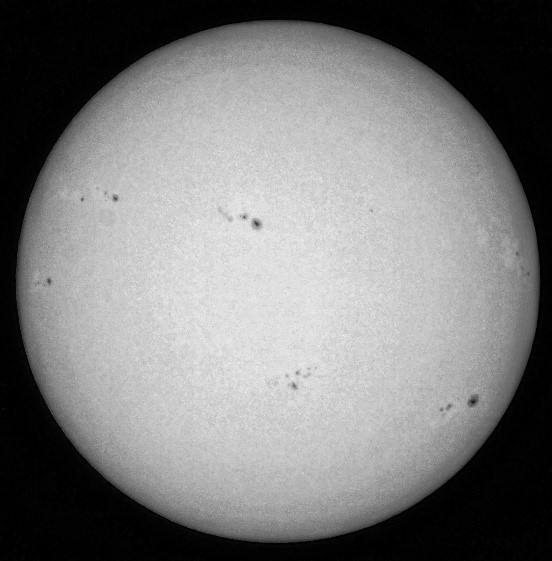
Though you may be interested in seeing what the Sun is doing. This is a photo I took a day or two ago using the 70mm ‘scope and Olympus camera. What you see are several Sunspot Groups across the solar disk, the larger ones at least Earth sized. Sunspots are the broken ends of huge magnetic twisted fields breaking through to the ‘surface’ of the Sun.
This photograph was take in July 2022
Polaris The North Star
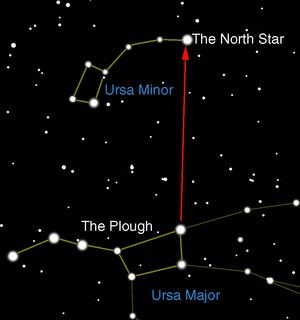
Can you find the North Star ‘Polaris’? Polaris is not the brightest star in the sky, as you would think it would be. However, it is the brightest one in the area. To find it of course you first need to know which way is north, use a compass certainly if you have one; or the sun at mid-day (without clouds of course), now turn around and you are roughly facing north. Even better if the sky is clear (!!!!) then use North Star ‘Polaristhe sky to navigate.
Look around the sky until you see a constellation group that looks like the one in the lower part of the photo, the one that looks like the outline of an old plough. Hence the name ’The Plough’ (in the UK, in the US it known as The Big Dipper). Use the two end stars as shown to ‘point’ to another star, the next one you come to is Polaris ‘The Pole Star’ in the constellation of the ‘Little Bear’. It is exactly due north but about half a degree from it, but it is a very useful starting point to other stars and constellations.
Have a go and see if you can find it. See the photograph on the side to help you